
Bespoke sizes, priced like you mean it.
Joinery lives or dies on quoting. The materials are easy enough to work out and the labour is where the money goes, which is exactly the part most systems will not model. Gydon holds the stages a product goes through, what each takes and what each costs, so a bespoke size is a calculation rather than a guess with a margin bolted on.
The finishing bay is on the quote, not in your head
A product carries its cutting list and its routing separately: the boards, sections and fixings on one side, and cut, machine, assemble, sand and finish on the other. Each stage has its own minutes and its own rate, because a finishing hour and a machining hour are not the same money.
Timber bought by the metre stays bought by the metre. Materials carry their own units, so a 2.4 metre length is not quietly rounded into "one".
- Multi-level bills of materials, so a door leaf costs through into the set
- Setup time charged once per job, so a one-off is not priced like a run of forty
- Cost of goods sitting on the product next to the price you are asking
- Exact decimal arithmetic, so a long cutting list does not drift by pennies
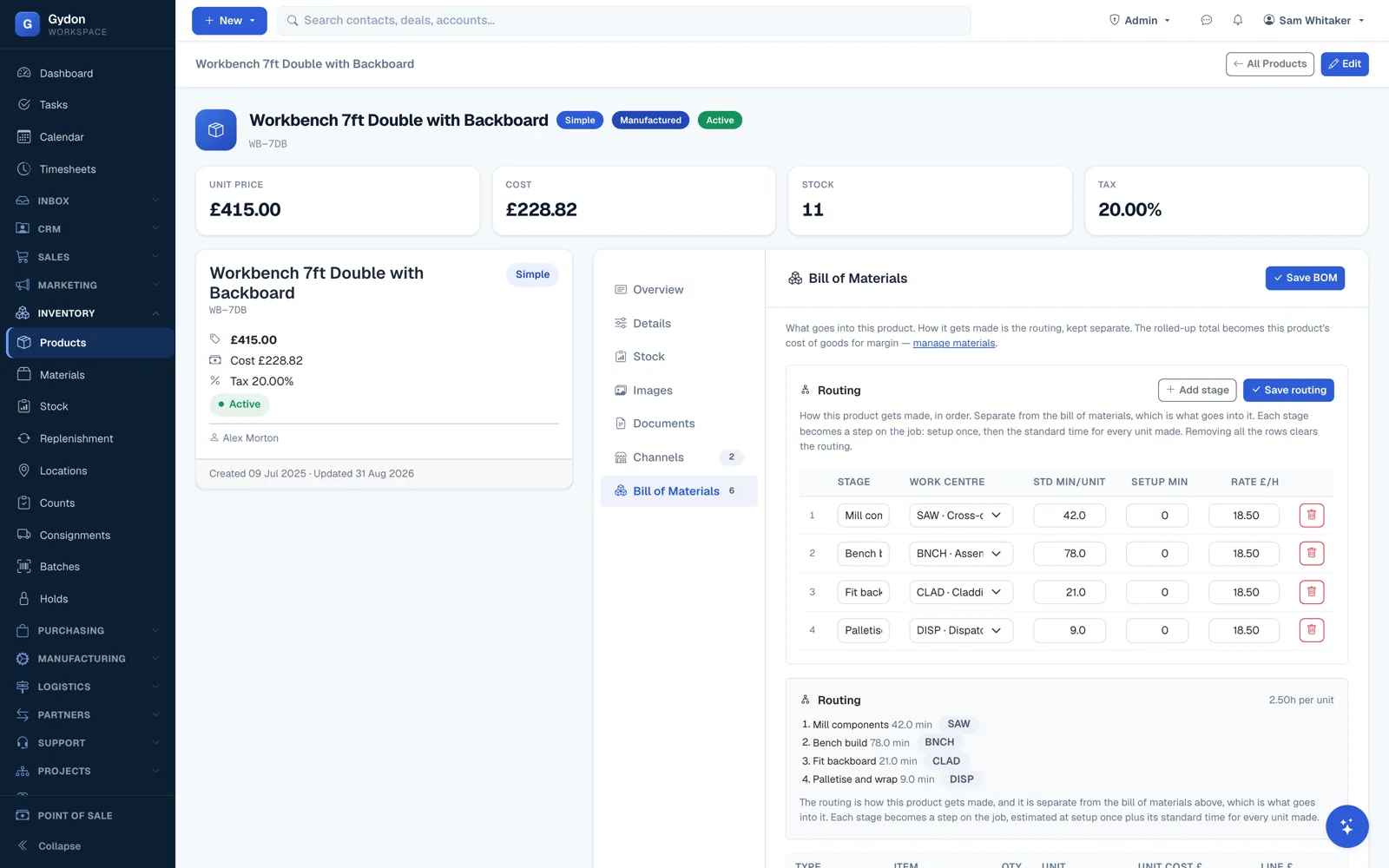
Routing above, cutting list below, on the same product.
What is on the bench, and what it actually took
Raise the job and the routing becomes real steps with owners, estimates and a clock. The bench clocks on and off at a tablet, so planned against actual is collected rather than reconstructed on Friday afternoon.
That is the number that tells you the truth about a product line: the one that always overruns on assembly, the one priced before the profile changed, the one where the finishing takes twice what anybody says it does.
- Jobs made over several sittings, with part quantities recorded as they come off
- Drawings and cut sheets attached to the product, opened at the bench
- Backward scheduling from the promised date, flagged when it will not fit
- Work centres, so two jobs wanting the same spindle moulder is visible in advance
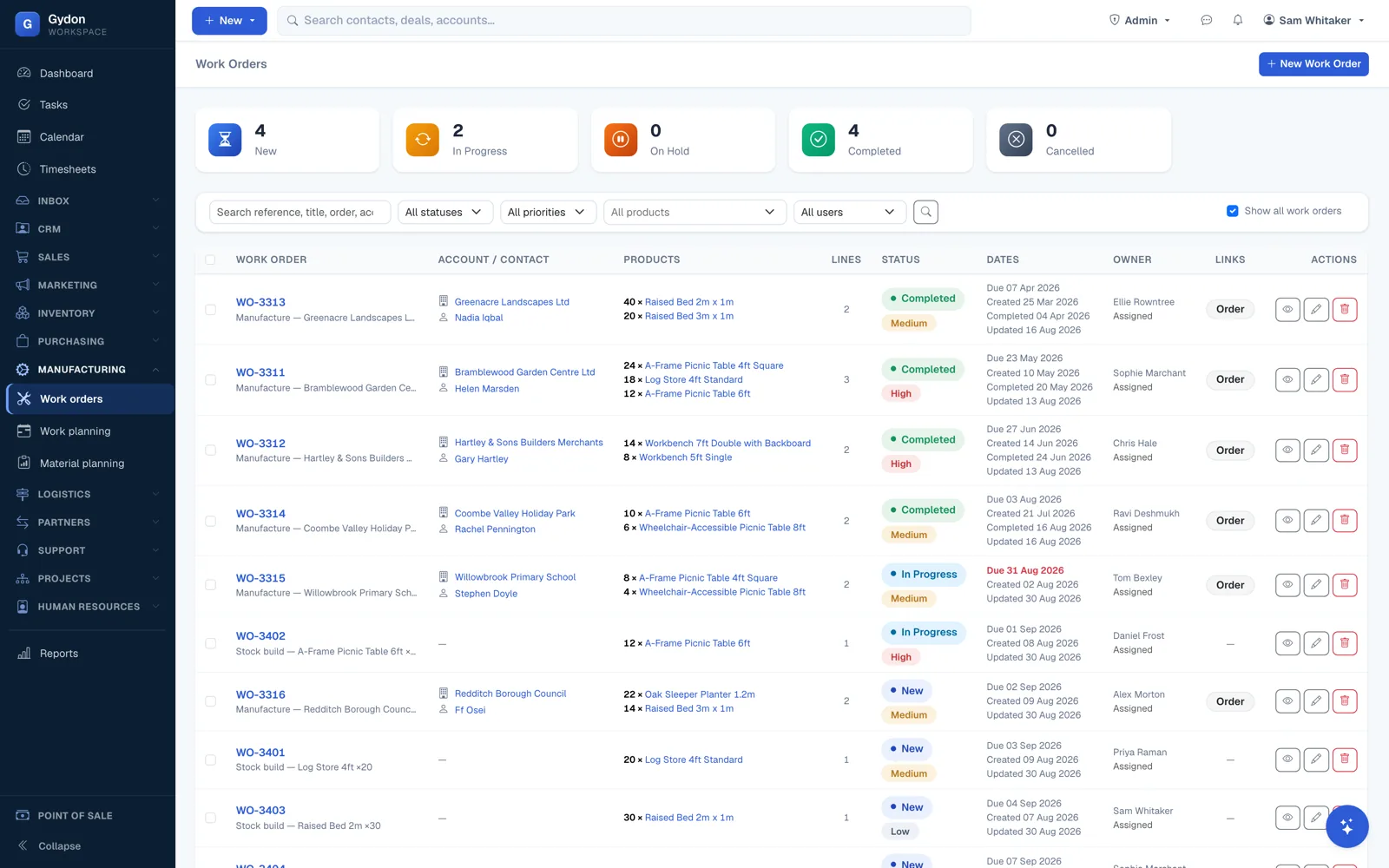
Every job on the floor, with what it is for and when it is due.
Two-man deliveries in your own vans
Joinery is awkward, heavy and easy to damage, which is why so much of it goes out on your own vehicles. Rounds are planned from the orders that are ready, sequenced, and handed to the driver's phone with proof of delivery captured at the door.
Because the round is built from the same orders the workshop is making, nothing has to be kept in step by hand.
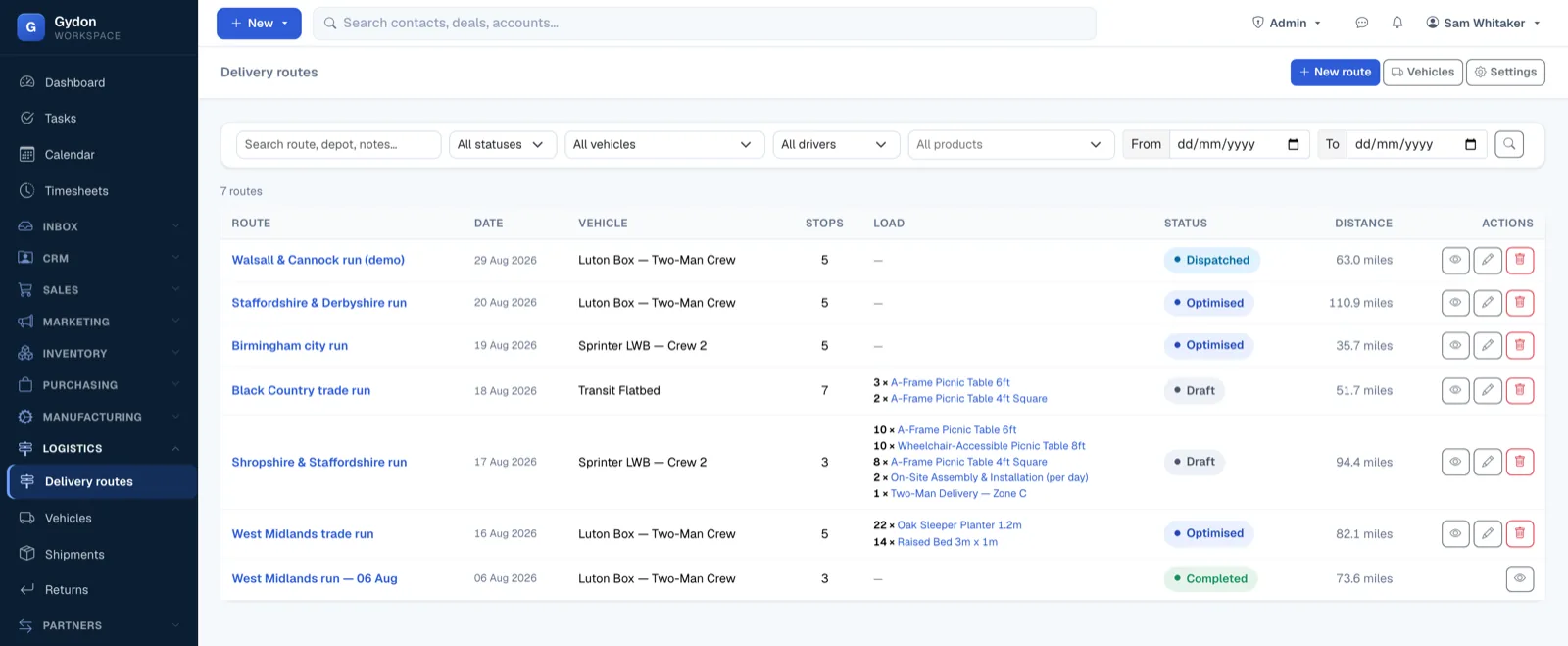
Tomorrow's rounds, built from orders that are ready to go.
What joinery workshops usually switch on
- Manufacturing and Product Costing
- Routing, work orders, bills of materials and cost of goods. The core of it for this trade.
- Inventory and Purchasing
- Boards, sections, ironmongery and finishes, with replenishment levels so the routine reordering stops being remembered.
- Shopfloor App
- A tablet at the bench for clocking on, recording what came off and reading the drawings.
- Logistics and the Driver App
- Rounds planned from real orders, run from a phone in the cab.
- CRM and sales documents
- Always included. Quotes, orders and invoices against the account, with your own paperwork on them.
- Probably not
- Marketplaces and point of sale, unless you also sell finished stock lines to the public.
Bring a product you make to size
On the demo, pick something bespoke you quoted recently. We will build its cutting list and routing in front of you and show you what it actually costs.