
Know what a job really costs, before it leaves the yard.
Gydon models how a product is actually made: the stages, the machines, the minutes and the people. That is what turns a guess at a price into a number you can defend, and a due date into something the floor can hit.
Two questions, kept apart
The bill of materials answers what goes into a product. The routing answers how it gets made. Bolting the second onto the first is what stops most systems being able to say which machine is the bottleneck, because labour ends up as just another line on a parts list.
In Gydon a routing is an ordered set of operations on the product. Each one carries a name, an optional work centre, the standard minutes per unit, the setup minutes charged once per job, and an hourly rate.
- Multi-line routings per product, in the order the work happens
- Work centres, so two jobs wanting the same saw is a visible fact
- Minutes held to four decimal places, because 0.43 hours is 25.8 minutes
- Rates per stage, so a finishing hour and a machining hour are not the same money
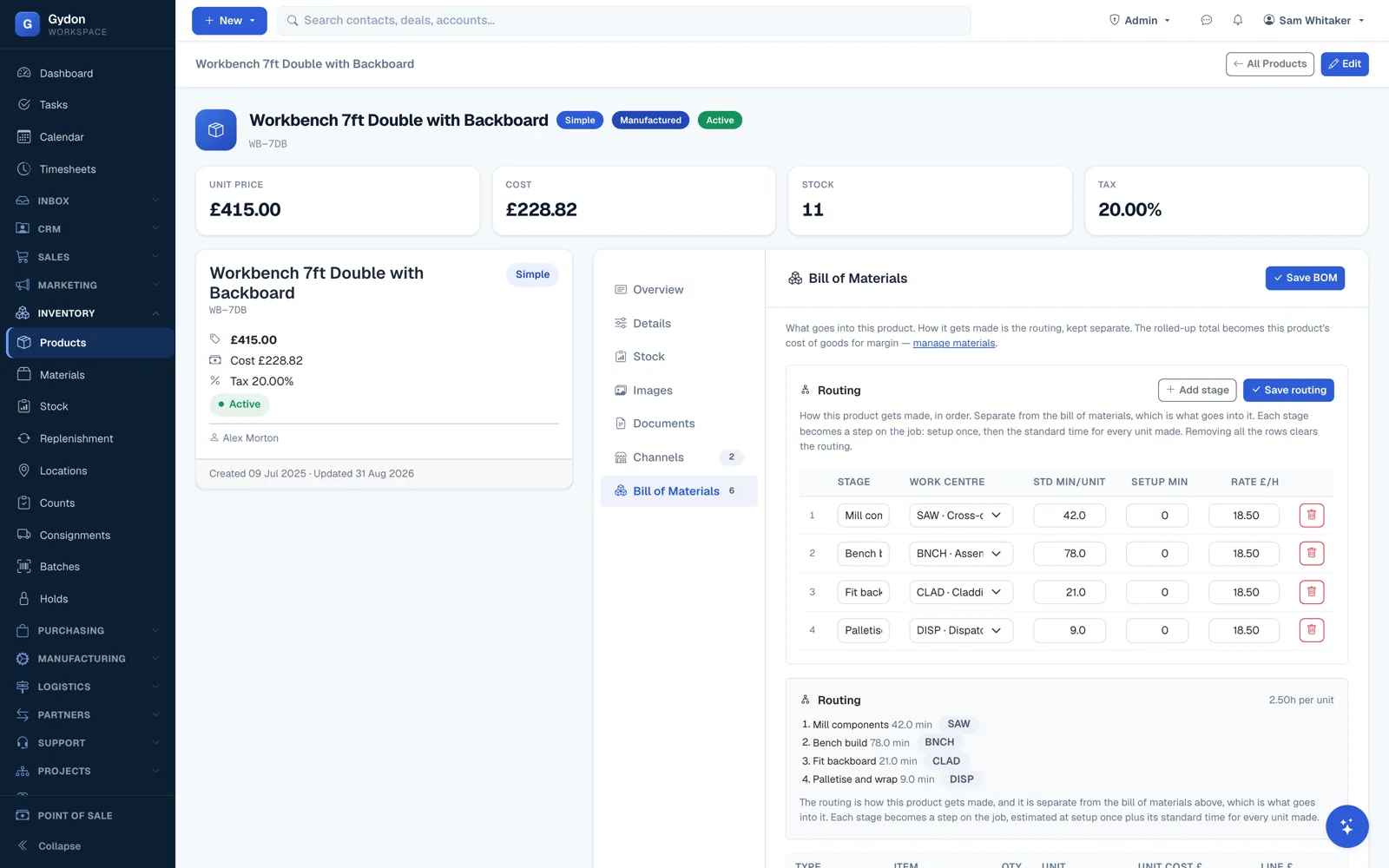
Routing above, bill of materials below, on the same product.
A production step is a task, not a special case
Raise a job and the routing becomes real steps against that work order. Because a step is an ordinary task, it inherits everything tasks already do: an estimate, an owner, a due date, a running clock, a completion, and a place in somebody's workload. Nothing had to be invented twice, and nothing about production sits outside the rest of the business.
Regenerating a routing matches steps to the operation that created them and updates them in place. Booked time stays booked, and whoever claimed a stage keeps it.
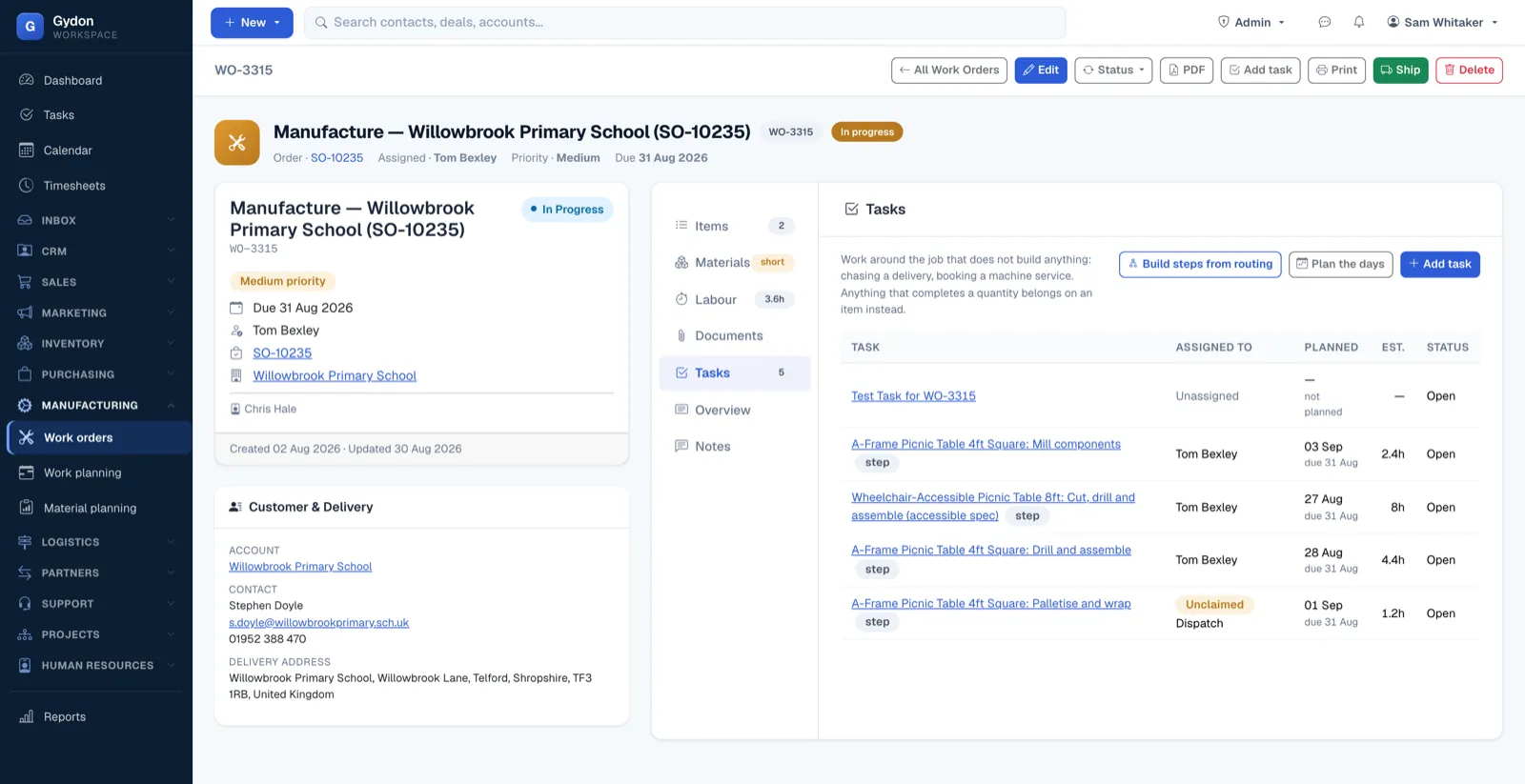
Planned against actual, per stage
Every stage carries what it should take. The bench records what it did take, by clocking on and off at the tablet. The difference is where the money is: the job that always overruns, the product that was priced before the design changed, the stage nobody remembers being this slow.
- A running clock per stage, not a timesheet filled in on Friday
- Shop floor time and project time in one model, so reporting spans both
- Job level clocking hides itself where a routing exists, so no hour is booked twice
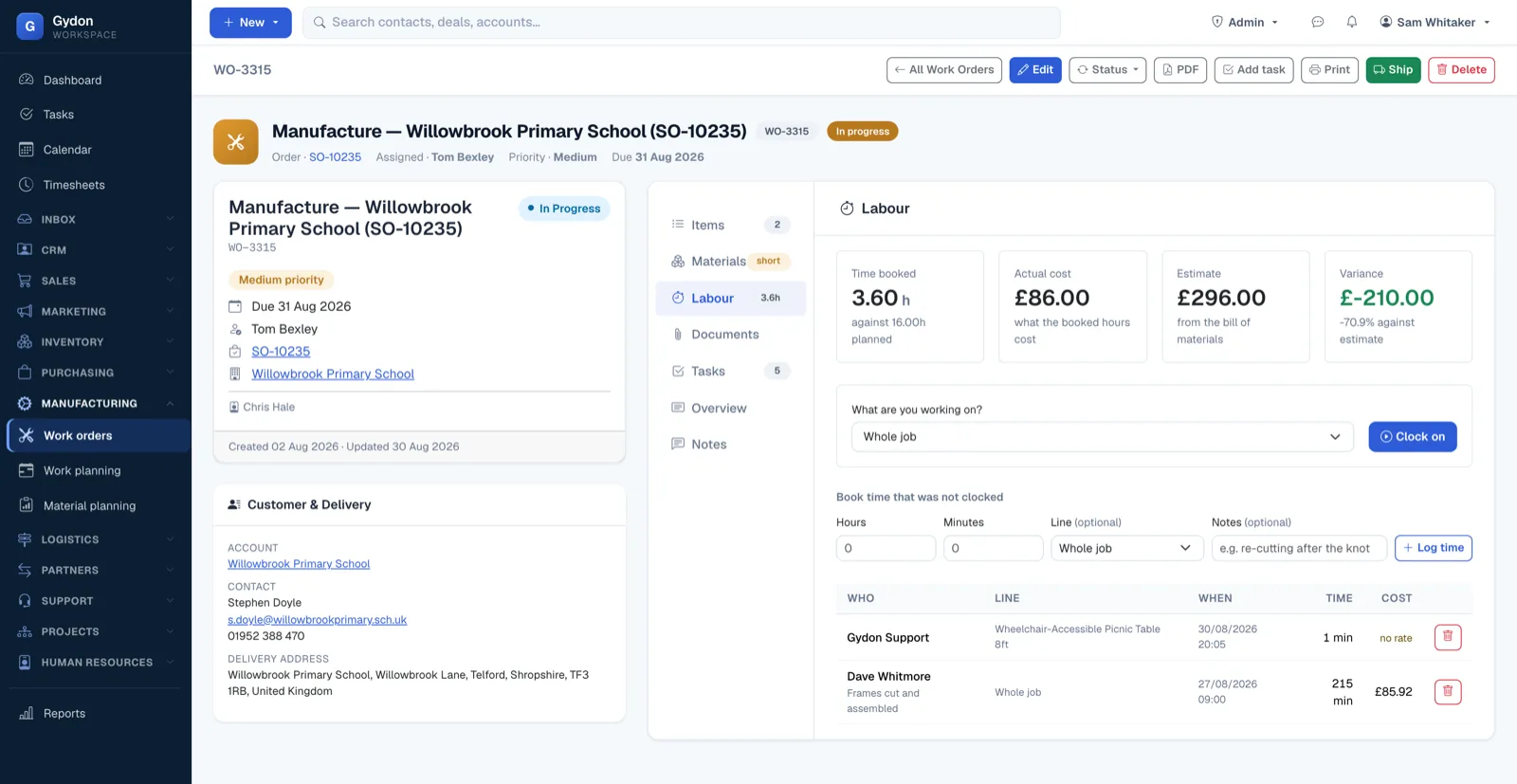
The arithmetic is the point
A costing engine that is nearly right is worse than useless, because you will not know which numbers to distrust. Two decisions in Gydon exist purely to keep the figures honest.
Exact decimals, never floating point
Costs are summed as decimal strings. Ordinary floating point arithmetic moved two products by a penny depending on nothing more than the order a loop ran in, because a value like £128.365 falls either side of the half penny. Money does not work that way, so neither does Gydon.
Setup is counted once per job
Setup time is charged to the job, not spread across the units. If it were spread, the same product would be worth different amounts on different orders purely because of batch size, and your margin per line would become fiction.
- Cost of goods roll-up
- Material lines plus routing time, rolled into a cost of goods figure that sits on the product next to its price.
- Multi-level bills of materials
- Sub-assemblies cost through to the finished item, so a change to a component moves everything above it.
- Material planning
- What the open jobs need, against what is in stock and what is already on order, so shortages surface before the bench finds them.
- Backward scheduling
- Stages are laid out backwards from the due date across working days. If the first stage would have to start before today, the job is reported late rather than quietly planned into the past.
- Job sheets
- The routing prints on the job sheet, scaled to the quantity being made and grouped by product, so the paper in the workshop matches the plan on screen.
Drag a stage to a different day
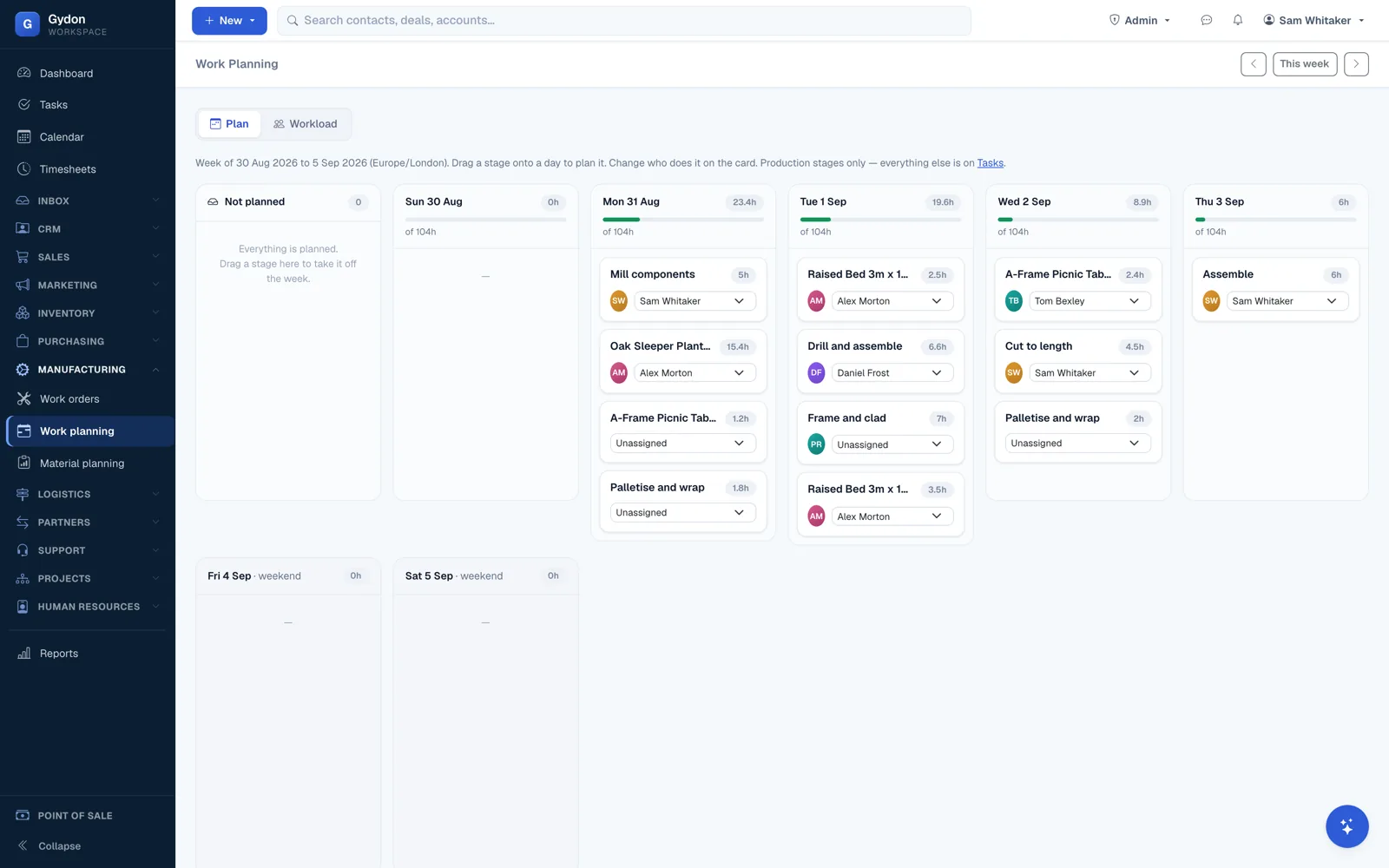
Work planning is a week of day lanes, each showing the hours planned against the hours available. Dragging earns its place here because position means something: Tuesday is a different commitment from Thursday. Who does the work is a dropdown on the card, not a second axis, because a grid of people against days gives you cells too small to aim at with gloves on.
The workload view answers the other half: what each person is committed to, and whether it fits. Jobs that have already generated steps are excluded from the job level total, so nobody appears to be working five hundred per cent of a week.
What sits around production
Production is not an island. These are the parts of Gydon it touches every day.
Stock and purchasing
Materials, suppliers, purchase orders and goods receipt, with the stock ledger behind them.
The shop floor app
A bench tablet that scans a job sheet, clocks on to a stage and shows the drawings.
Delivery
Shipments, multi-stop rounds and proof of delivery, planned from the same orders.
Trading Partners
When the company on the other end runs Gydon too, their order arrives as your order and their invoice arrives already checked against what turned up.
Bring us a product and we will route it
On the demo, pick something you actually make. We will build its routing in front of you and show you what it costs.